

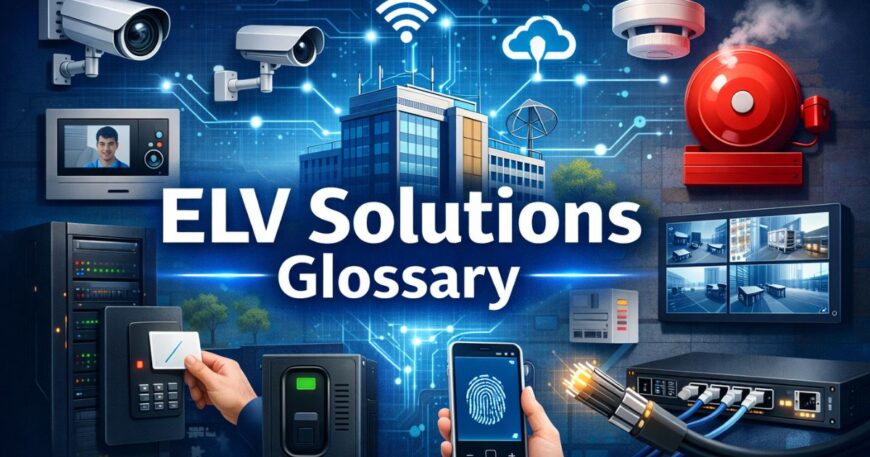
Extra Low Voltage (ELV) systems play a key role in modern buildings by supporting security, communication, and automation technologies. Businesses, residential communities, and commercial buildings rely on solutions like CCTV surveillance, gate barriers, access control systems, intercoms, IP telephony, structured cabling, and home automation to improve safety and operational efficiency.
This glossary explains commonly used terms related to these ELV systems to help users understand the technologies used in modern infrastructure.
1. CCTV System Glossary
A
Analog Camera
A traditional CCTV camera that transmits video signals to a Digital Video Recorder (DVR) through coaxial cables.
Angle of View
The area that a CCTV camera can capture within its field of vision.
Automatic Gain Control (AGC)
A feature that automatically adjusts camera sensitivity to improve image quality in low-light conditions.
B
Bandwidth
The amount of data that can be transmitted over a network connection affects the quality and speed of video streaming.
Bullet Camera
A cylindrical-shaped CCTV camera is commonly used for outdoor surveillance and long-distance monitoring.
C
CCTV (Closed Circuit Television)
A video surveillance system that transmits signals to a specific set of monitors or recording devices for security monitoring.
CCTV Camera
A device used to capture video footage in a surveillance system.
Cloud Storage
A remote storage system where CCTV footage is stored online instead of on physical recording devices.
Compression
A process used to reduce the size of video files for efficient storage and transmission.
Control Room
A central location where surveillance footage from CCTV cameras is monitored.
D
Day/Night Camera
A camera designed to capture clear images during both daylight and nighttime conditions.
Digital Video Recorder (DVR)
A recording device used to store footage from analog CCTV cameras.
Dome Camera
A dome-shaped surveillance camera is commonly used indoors due to its wide-angle coverage and discreet design.
Dynamic Range
The ability of a camera to capture details in both bright and dark areas of an image.
F
Field of View (FOV)
The visible area that a CCTV camera can monitor.
Fixed Lens Camera
A camera with a fixed focal length that cannot zoom or adjust its viewing angle.
Frame Rate (FPS)
The number of frames captured per second in a video recording.
H
HD CCTV Camera
A high-definition surveillance camera that captures clearer and more detailed video footage.
H.264 / H.265 Compression
Video compression standards are used to reduce storage space while maintaining video quality.
I
Infrared (IR) Camera
A CCTV camera equipped with infrared LEDs to capture images in low-light or nighttime conditions.
IP Camera
A digital camera that transmits video data through an internet network.
Image Sensor
A component in a camera that converts light into electronic signals to create images.
L
Lens
The optical component of a camera that focuses light onto the image sensor.
Low Light Camera
A camera designed to capture clear footage in environments with minimal lighting.
M
Motion Detection
A feature that detects movement within the camera’s view and triggers recording or alerts.
Megapixel Camera
A camera capable of capturing high-resolution images measured in megapixels.
N
Network Video Recorder (NVR)
A recording device used to store video footage from IP cameras.
Night Vision
A feature that allows cameras to capture images in dark environments using infrared technology.
O
On-Screen Display (OSD)
A camera feature that shows information such as time, date, and camera settings on the video feed.
P
Pan-Tilt-Zoom (PTZ) Camera
A camera capable of moving horizontally, vertically, and zooming to monitor large areas.
Power over Ethernet (PoE)
A technology that allows both power and data to be transmitted through a single network cable.
R
Remote Viewing
The ability to access CCTV footage from a smartphone, tablet, or computer through the internet.
Resolution
The clarity of an image or video is usually measured in pixels.
S
Surveillance System
A complete security monitoring system that includes cameras, recorders, and monitoring software.
Storage Capacity
The amount of video data that can be stored on a DVR, NVR, or cloud storage system.
V
Video Analytics
Software technology is used to analyze CCTV footage for detecting specific activities such as motion, intrusion, or facial recognition.
Video Management System (VMS)
Software used to manage, record, and monitor multiple CCTV cameras.
W
Wide Dynamic Range (WDR)
A feature that allows cameras to capture clear images in scenes with both bright and dark areas.
Wireless CCTV Camera
A surveillance camera that transmits video signals wirelessly instead of using cables.
Z
Zoom Lens
A lens that allows the camera to magnify objects without changing the camera position.
2. Gate Barrier Terminology
A
Access Control Integration
The process of connecting a gate barrier system with access control technologies such as RFID cards, biometric systems, or mobile access.
Automatic Boom Barrier
A motorized barrier arm that automatically lifts and lowers to control vehicle entry and exit at restricted areas.
ANPR (Automatic Number Plate Recognition)
A camera-based system that automatically reads vehicle license plates and grants access based on authorized records.
B
Barrier Arm
The horizontal pole of a gate barrier that moves up and down to block or allow vehicle access.
Barrier Gate System
A traffic control system that uses automated barriers to regulate vehicle entry and exit.
Boom Barrier
A commonly used gate barrier system with a long arm that raises and lowers to control vehicle movement.
C
Control Panel
The electronic control unit that manages the operation of the gate barrier system.
Counterweight System
A mechanism used to balance the barrier arm and ensure smooth movement.
D
Drive Motor
The motor is responsible for lifting and lowering the barrier arm.
E
Emergency Release System
A feature that allows the barrier to be opened manually during power failures or emergencies.
F
Flashing Warning Light
A safety light is installed on the barrier to alert drivers when the gate is moving.
G
Gate Barrier System
An automated traffic management system used to control vehicle entry at parking lots, residential communities, and commercial properties.
H
Hydraulic Barrier System
A type of gate barrier that uses hydraulic mechanisms for smoother and heavier-duty operation.
L
Loop Detector
A sensor installed under the road surface that detects the presence of vehicles near the barrier.
Limit Switch
A device that controls the stopping points of the barrier arm when it is fully open or closed.
M
Manual Override
A feature that allows operators to manually control the barrier in case of system malfunction.
P
Parking Management System
A system integrated with gate barriers to regulate parking access and vehicle flow.
Photoelectric Sensor
A safety sensor that detects obstacles in the barrier’s path and prevents it from closing on vehicles.
R
RFID Vehicle Access System
A system that uses RFID tags installed in vehicles to automatically open gate barriers when authorized vehicles approach.
Remote Control Operation
A method of controlling gate barriers using a handheld remote device.
S
Safety Sensor
A sensor that detects objects or vehicles under the barrier to prevent accidents.
Smart Parking System
An automated parking management system integrated with barriers and sensors.
T
Traffic Control Barrier
A barrier system used to regulate vehicle movement in restricted or high-traffic areas.
Ticketing System
A system used in parking facilities where vehicles receive entry tickets that allow barrier access.
V
Vehicle Access Control System
A system that manages vehicle entry using gate barriers, RFID tags, or license plate recognition technology.
W
Wireless Barrier Control
A system that allows gate barriers to be operated using wireless communication technologies.
3. Access Control System Glossary
A
Access Card
A plastic card embedded with RFID or magnetic technology is used to grant authorized entry to secured areas.
Access Control System
A security system that manages and monitors who can enter or exit a building or restricted area.
Access Credential
A form of identification used to gain access, such as a card, PIN code, biometric data, or mobile credential.
Access Level
The permissions assigned to a user that determine which areas they are allowed to enter.
Access Log
A digital record that tracks entry and exit activities within the access control system.
Authentication
The process of verifying the identity of a user before granting access.
B
Biometric Access Control
A security system that uses biological characteristics such as fingerprints, facial recognition, or iris scans to verify identity.
Biometric Reader
A device that scans biometric data such as fingerprints or facial features for authentication.
C
Card Reader
A device used to read access cards and verify whether a user is authorized to enter a secure area.
Credential Management
The process of issuing, updating, and revoking access credentials within a system.
D
Door Controller
An electronic device that manages door locks and communicates with the access control system.
Door Strike
An electronic locking device installed in door frames that releases when access is granted.
E
Electronic Access Control (EAC)
A modern security system that uses electronic devices to regulate entry to buildings or rooms.
Entry Management System
A system used to manage and monitor entry points in a facility.
F
Facial Recognition System
A biometric technology that identifies individuals by analyzing facial features.
K
Keypad Access Control
A system where users enter a PIN code on a keypad to gain entry.
M
Multi-Factor Authentication (MFA)
A security method requiring two or more verification methods such as card access plus fingerprint.
P
Proximity Card (RFID Card)
A contactless card used in access control systems to grant entry when placed near a card reader.
R
RFID (Radio Frequency Identification)
A wireless technology used in access cards and tags for secure identification.
Role-Based Access Control (RBAC)
A security model where access permissions are assigned based on user roles within an organization.
S
Smart Card
An advanced access card embedded with a microchip for secure authentication.
T
Time and Attendance System
A system integrated with access control to track employee entry, exit, and working hours.
Turnstile Access Control
A physical access gate used in offices, stadiums, and transportation hubs to regulate pedestrian entry.
U
User Authentication
The process of verifying a user’s identity before granting access.
V
Visitor Management System
A system used to register and manage visitors entering a facility.
W
Wireless Access Control
An access control system that operates through wireless communication instead of physical wiring.
4. Intercom System Glossary
A
Apartment Intercom System
An intercom communication system is used in apartment buildings to allow residents to communicate with visitors at the entrance.
Audio Intercom
A basic intercom system that supports voice communication between two or more locations.
Access Integration
The process of connecting intercom systems with access control systems to allow door unlocking after communication.
B
Base Station
The central intercom unit that connects and manages multiple intercom devices in a system.
Building Entry System
An intercom system is installed at building entrances to allow visitors to communicate with occupants before entry is granted.
C
Call Button
A button installed on an intercom panel that visitors press to initiate communication with a resident or office.
Central Control Unit
The main device responsible for managing communication signals between intercom units.
D
Door Entry Intercom
A communication system installed at doors or gates that allows visitors to communicate with occupants before gaining entry.
Door Release Function
A feature that allows the user to remotely unlock a door through the intercom system.
H
Hands-Free Intercom
An intercom device that allows communication without lifting a handset.
I
Intercom System
A communication system that allows voice or video communication between different locations within a building.
IP Intercom System
A modern intercom system that uses Internet Protocol networks for communication.
M
Master Station
The primary intercom unit that controls communication with other intercom stations.
S
Substation
A secondary intercom unit connected to the master station for communication.
V
Video Door Phone
An intercom system equipped with a camera that allows residents to see visitors before granting entry.
Video Intercom System
An intercom communication system that supports both audio and video interaction.
W
Wall-Mounted Intercom
An intercom device is installed on walls for convenient access.
Wireless Intercom System
An intercom communication system that operates without physical cables using wireless technology.
5. IP Telephony Glossary
A
Auto Attendant
An automated system that answers incoming calls and directs callers to the appropriate department or extension without human intervention.
Analog Telephone Adapter (ATA)
A device that allows traditional analog telephones to connect to a VoIP network.
B
Bandwidth
The amount of network capacity available for transmitting voice data over the internet.
C
Call Forwarding
A feature that automatically redirects incoming calls to another number or extension.
Call Routing
The process of directing incoming calls to specific extensions or departments based on predefined rules.
Conference Calling
A feature that allows multiple participants to join a single phone call.
D
Dial Plan
A configuration that determines how calls are routed within an IP telephony system.
E
Extension Number
A short internal number assigned to a user or department within a phone system.
G
Gateway
A device that connects VoIP networks with traditional telephone networks.
I
IP Phone
A telephone device designed to transmit voice communication over an IP network.
IP PBX (Internet Protocol Private Branch Exchange)
A telephone system that manages internal and external calls over an internet network.
IP Telephony
A communication technology that enables voice calls to be transmitted through Internet Protocol networks.
J
Jitter
A variation in packet arrival time that can affect voice call quality.
L
Latency
The delay between sending and receiving voice data during a call.
P
Packet
A small unit of digital data transmitted across a network during a VoIP call.
PBX (Private Branch Exchange)
A private telephone network used within an organization to manage internal and external calls.
S
Session Initiation Protocol (SIP)
A communication protocol used to establish, manage, and terminate VoIP calls.
Softphone
A software-based phone application that allows users to make calls from a computer or smartphone.
V
VoIP (Voice over Internet Protocol)
A technology that allows voice communication to be transmitted over the internet.
VoIP Gateway
A device that connects VoIP networks with traditional telephone systems.
6. Structured Cabling / Fibre Cabling Glossary
A
Adapter
A connector device used to join two fiber optic cables together.
Armored Fiber Cable
A fiber optic cable is protected with a metal layer to prevent physical damage.
B
Backbone Cabling
The main network cabling that connects different floors or departments within a building.
Bandwidth
The amount of data that can be transmitted through a network cable within a given time.
C
Cat5e Cable
A twisted pair Ethernet cable used in structured cabling systems that supports speeds up to 1 Gbps.
Cat6 Cable
An enhanced Ethernet cable capable of supporting higher speeds and reduced interference compared to Cat5e.
Cat6A Cable
An advanced category cable designed to support high-speed networks up to 10 Gbps.
Cable Management System
A system used to organize and route cables within racks, walls, or ceilings.
Connector
A device used to connect cables to network equipment.
D
Data Cabling
Cabling infrastructure used to transmit digital data between network devices.
Distribution Frame
A centralized location where network cables are connected and managed.
F
Fiber Optic Cable
A high-speed cable that transmits data using light signals through glass or plastic fibers.
Fiber Patch Cord
A short fiber cable is used to connect network equipment to patch panels.
Fiber Splicing
The process of joining two fiber optic cables together to maintain signal continuity.
L
LAN (Local Area Network)
A network that connects computers and devices within a building or office environment.
M
Multimode Fiber
A type of fiber optic cable designed for shorter distance data transmission within buildings.
N
Network Rack
A cabinet used to house networking equipment such as switches, patch panels, and servers.
Network Switch
A device that connects multiple network devices and manages data traffic within a network.
Optical Fiber
A thin strand of glass or plastic used to transmit data as light signals.
P
Patch Panel
A panel used to organize and manage network cable connections.
PoE (Power over Ethernet)
A technology that allows network cables to carry electrical power along with data to devices like IP cameras or wireless access points.
S
Single Mode Fiber
A type of fiber optic cable used for long-distance data transmission with higher bandwidth.
Structured Cabling System
A standardized cabling infrastructure that supports multiple communication services such as data, voice, and video.
T
Termination
The process of connecting cable ends to connectors or patch panels.
U
UTP Cable (Unshielded Twisted Pair)
A commonly used Ethernet cable type without shielding, used in structured cabling networks.
W
Work Area Outlet
A wall-mounted port that connects user devices to the structured cabling network.
7. Home Automation Glossary
A
Automation Controller
The central device that manages and controls all connected smart home systems, like lighting, security, climate, and entertainment.
Ambient Sensors
Sensors that detect environmental conditions such as temperature, humidity, and light, enabling automatic adjustments.
Android Automation App
A mobile application used on Android devices to control and monitor smart home systems remotely.
Apple HomeKit
A smart home platform by Apple that allows users to control compatible devices using the Home app or Siri.
Artificial Intelligence (AI) in Home Automation
Technology that enables systems to learn user behavior and automate actions like lighting and temperature control.
Automated Blinds / Smart Curtains
Motorized window coverings that operate automatically based on schedules, sunlight, or user commands.
Automation Hub
A central device or software that connects and coordinates communication between multiple smart devices.
B
Biometric Access Control
A security system that uses fingerprint, facial recognition, or other biometric data for entry.
Building Management System (BMS)
A centralized system used to monitor and control building operations like HVAC, lighting, and security.
C
Cloud-Based Automation
Smart home systems that operate via cloud servers, allowing remote access through the internet.
Control Panel
A wall-mounted touchscreen or digital interface used to manage home automation systems.
Connected Devices
Devices linked to a smart system via WiFi, Zigbee, Z-Wave, or Bluetooth.
D
Dimming Control
Technology used to adjust lighting brightness manually or automatically.
Door & Window Sensors
Sensors that detect opening or closing and trigger alerts or automation responses.
E
Energy Management System
A system that monitors and optimizes energy consumption in a home.
G
Geofencing
A GPS-based feature that triggers automation when users enter or leave a defined area.
H
HVAC Automation
Automated control of heating, ventilation, and air conditioning systems for comfort and efficiency.
I
IoT (Internet of Things)
A network of connected devices that communicate and exchange data over the internet.
Integration
The ability to connect multiple smart systems into one unified platform.
L
Lighting Automation
Smart lighting control based on schedules, occupancy, or remote commands.
M
Motion Sensor
A device that detects movement and triggers actions like lighting or security alerts.
Multi-Room Audio System
A system that enables audio playback across multiple rooms simultaneously or independently.
O
Occupancy Sensor
A sensor that detects presence in a room and adjusts lighting or HVAC accordingly.
R
Remote Access
The ability to control smart home systems from anywhere via mobile or web devices.
S
Scene Control
A feature that activates multiple devices with one command (e.g., “Movie Mode”).
Smart Door Lock
A digital lock controlled via smartphone, passcode, or biometrics.
Smart Lighting
Lighting systems that can be automated, scheduled, or remotely controlled.
Smart Plug
A plug that allows traditional appliances to be controlled via a smart system.
Smart Security System
An integrated system with cameras, alarms, and sensors for home protection.
Smart Thermostat
A thermostat that adjusts temperature automatically based on user habits and conditions.
Smart Irrigation System
An automated watering system that adjusts based on weather and soil conditions.
Smart Surveillance Cameras
Internet-enabled cameras for remote home monitoring.
Scheduling Automation
Setting predefined times for devices to operate automatically.
T
Touchscreen Interface
A wall-mounted screen used to control and monitor home automation systems.
V
Voice Control
The ability to operate smart devices using voice commands via assistants.
W
WiFi Automation
Devices that connect directly to a home’s WiFi network for control and communication.
Z
Zigbee Protocol
A low-power wireless communication protocol used in smart home devices.
Z-Wave Protocol
A wireless protocol specifically designed for home automation systems.
